ATF Study Group Session 4| Transition finance for hard-to-abate sectors in Asia - Challenges and Unlocks
03 July 2026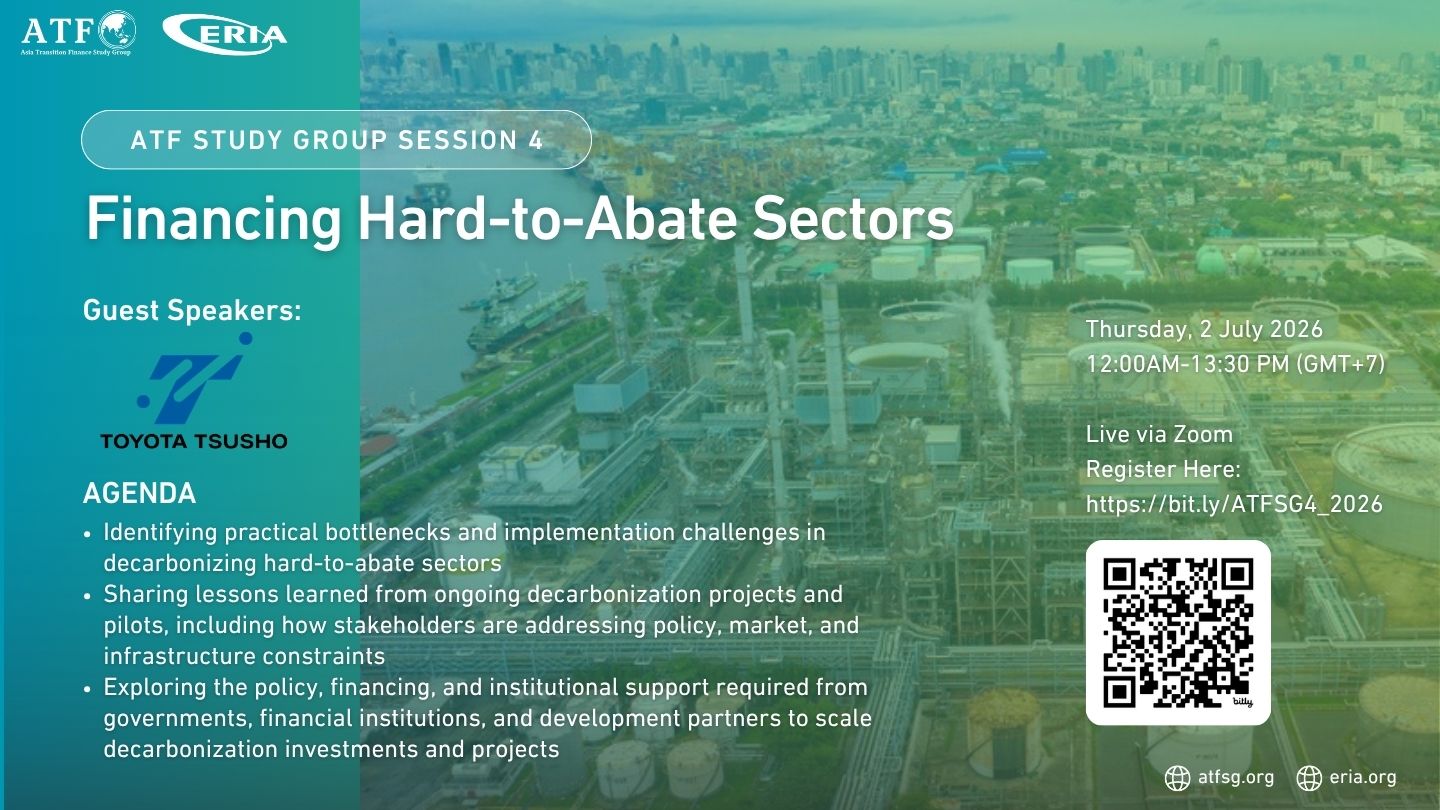
The Asia Transition Finance Study Group (ATF SG) held the fourth study group session of 2026 on 2 July (Thu).
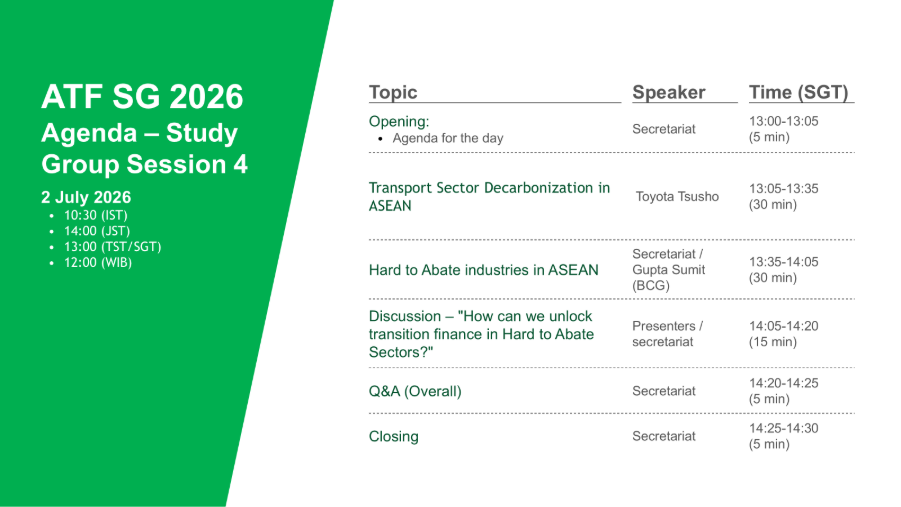
The Asia Transition Finance Study Group (ATF SG) held the fourth study group session of 2026 on 2 July (Thu) via Zoom. The session focused on the challenges and potential unlocks for transition finance in hard-to-abate sectors across Asia, drawing on project experience in transport sector decarbonisation as well as a broader analysis of the cement and steel industries in ASEAN.
The Secretariat opened the session with an overview of the day's agenda and a brief recap of the third study group session, which had explored CCGT-CCUS as a transition enabler for Asia. Participants were invited to respond to a pulse survey on the biggest bottlenecks in financing hard-to-abate sector decarbonisation before the main presentations began. The Secretariat also provided context on the scale of the challenge, noting that transportation and industry together account for close to half of ASEAN's greenhouse gas emissions and continue to grow.
The session's first guest presentation was delivered by PT. Toyota Tsusho Indonesia. They presented their current transport decarbonization project, including live demonstrations and use of biofuels, and shared views around the institutional and market gaps — including the absence of a national schemes that incentivise use of such biofuels — that prevent these projects from reaching financeable status on commercial terms alone.
Mr. Sumit Gupta, Managing Director and Senior Partner at Boston Consulting Group, presented an analysis of hard-to-abate industries in ASEAN, focusing on cement and steel. He outlined the sector-level emission trends, the diversity of regulatory environments across ASEAN countries, and the specific decarbonisation levers and constraints relevant to each industry. For both sectors, he underscored that deep decarbonisation ultimately requires ecosystem-level approaches for technologies such as CCUS and green hydrogen.
A panel discussion followed, bringing together the Toyota Tsusho presenters alongside Mr. Sumit Gupta and Mr. Varad Pande, Partner and Director at Boston Consulting Group. The discussion explored three questions: how public and private actors can collaborate to enable decarbonisation in hard-to-abate sectors; how to create credible demand and offtake so transition projects have sustainable cash flows; and what risk-sharing structures are needed to make first-of-a-kind or early transition projects bankable.
The session concluded with engaging discussion among participants.