ATF Study Group Session 7 - 2026 Comparative Analysis of Regional and National Taxonomies
21 September 2026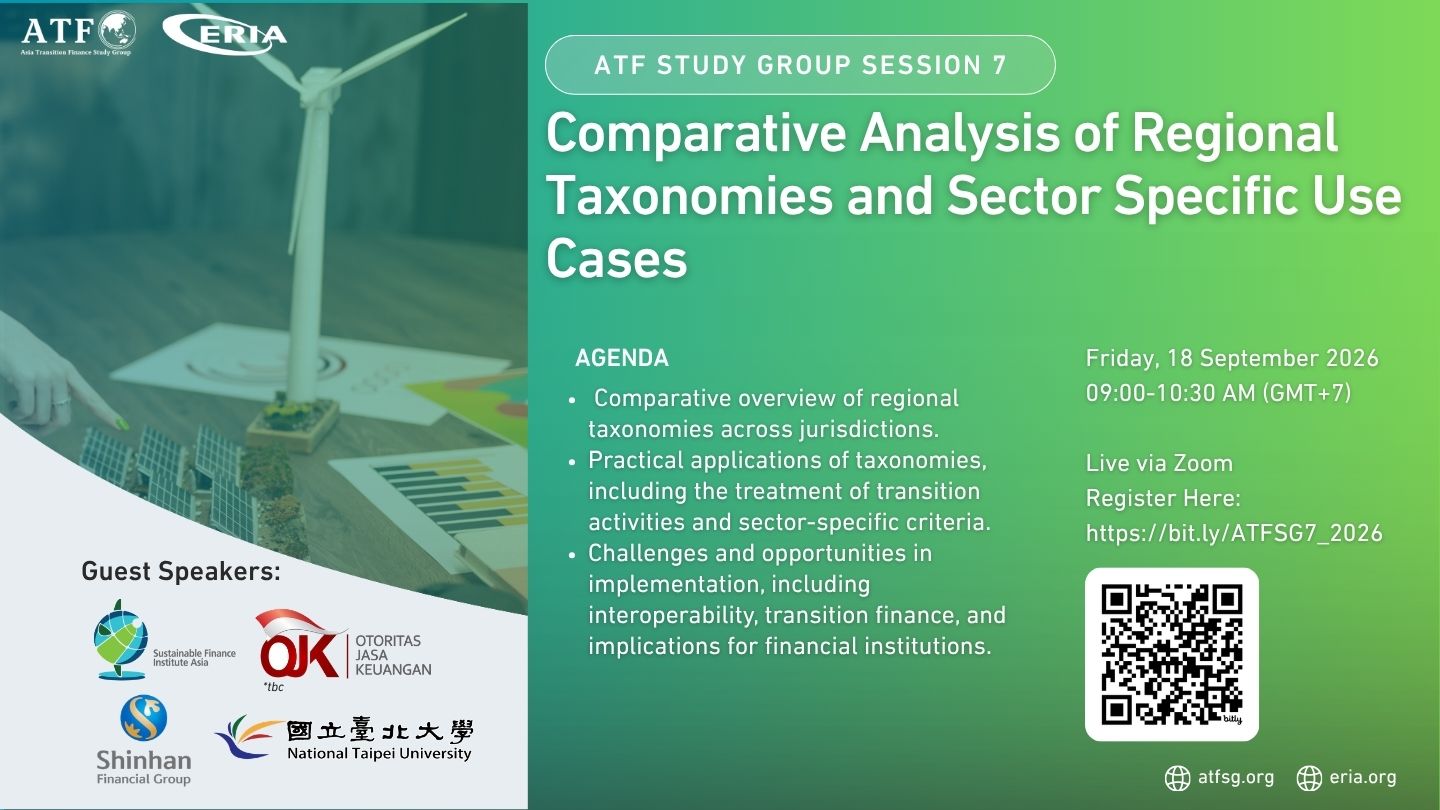
The Asia Transition Finance Study Group (ATF SG) held the seventh study group session of 2026 on 18 September (Fri).
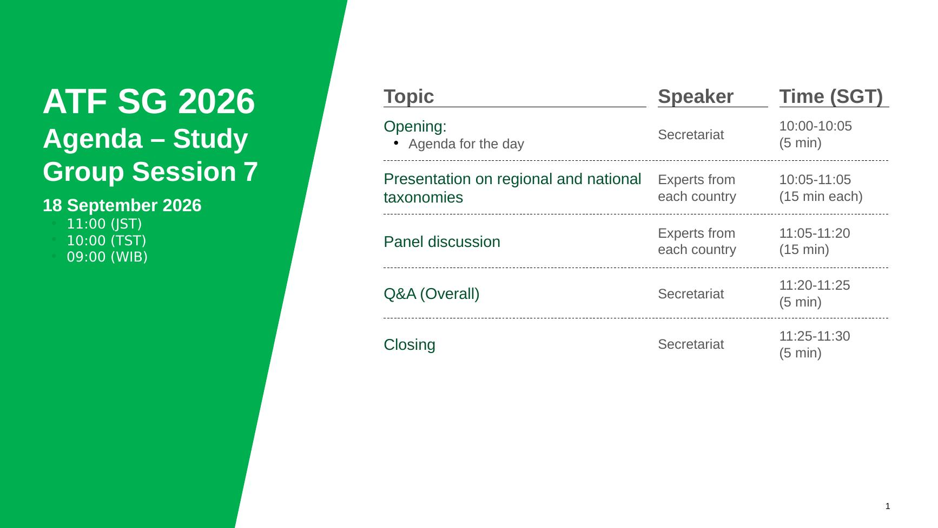
The ATF SG held its seventh study group session of 2026 on 18 September via Zoom, focusing on how regional and national taxonomies compare and how they are applied in practice. The final thematic session of this year’s programme, it featured four presentations from regional and national taxonomy experts, authorities and practitioners, followed by a panel discussion.
The Secretariat opened with a pulse survey on what would most increase participants’ confidence in applying taxonomies to transition finance decisions. After several years in which taxonomies have proliferated, the ASEAN Taxonomy provides the common regional reference while national taxonomies reflect domestic policy, market structure and transition pathways. Taxonomies remain one input into financing decisions, alongside regulation, internal standards and sector pathways, so what matters is not only how they differ but how those differences shape their use within each market.
Mr. Eugene Wong, Chief Executive Officer of the Sustainable Finance Institute Asia, which hosts the ASEAN Taxonomy Board, presented the ASEAN Taxonomy for Sustainable Finance Version 4. Version 4, released in November 2025, completes the development phase, with technical screening criteria across all six focus and three enabling sectors. He explained the tiered traffic-light design, including the Amber tiers that accommodate a transition journey and are to be retired over time, the complementary role of the ASEAN Transition Finance Guidance, and the ACCEPT platform for comparing classifications across taxonomies.
Mr. Reyhan Adnan Ahmad, Senior Manager in the Directorate of Sustainable Finance at Otoritas Jasa Keuangan (OJK), presented the Indonesian Taxonomy for Sustainable Finance and its place within a wider sustainable finance architecture, together with the Taxonomy Navigator developed to support day-to-day application by financial institutions. He positioned the taxonomy as a "common language" to classify sustainable activities, serving as the foundation and reference for sustainable finance policies, financial product/service indicators, and various other policy-formulation.
Dr. Chi-Jui Huang, Dean of the College of Business at National Taipei University, presented the Taiwan Sustainable Taxonomy, its alignment categories and the disclosure practice now emerging among listed companies.
Mr. Namkyoon Kim of the Korea Environmental Industry & Technology Institute (KEITI) and Mr. Jihyun Kim of Shinhan Financial Group then presented the K-Taxonomy and its use in green bond and securitisation programmes, and how a financial institution embeds taxonomy classification in its transition finance framework and portfolio management.
The panel discussion addressed three questions: how practitioners determine which regional or national taxonomy to reference, and how other guidelines and taxonomies from outside the region fit in; where taxonomies sit within institutions’ own frameworks and credit processes; and what would most help practitioners apply them.
Across the presentations, a common theme was that taxonomies are increasingly moving from design to implementation. National taxonomies tend to serve domestic regulatory and market needs, while the ASEAN Taxonomy can provide a common reference for cross-border comparability. Practical tools, incentives and clearer guidance on how different frameworks interact will be important to further adoption.
The session concluded with the Secretariat announcing that the eighth study group session is planned for around October.